Hanyfah: A Dazzling Script Font for Small Business Branding
Last week, I sat down at my kitchen table with a stack of kraft paper boxes, a roll of twine, and a fresh test print of a logo I had been fiddling with for days. I run a small handmade candle business on the side, and I was finally ready to refresh my packaging. My old labels were functional but flat—just my business name in a basic sans serif that could belong to anyone. I wanted something that felt like me: warm, handcrafted, a little elegant, and unmistakably personal. That is when I opened a file for a font called Hanyfah, dropped my business name into the preview, and literally stopped mid-sip of my coffee. The letters danced. I knew right then this script font was about to change everything about how my brand looked and felt.
What Makes Hanyfah a Game Changer for Branding
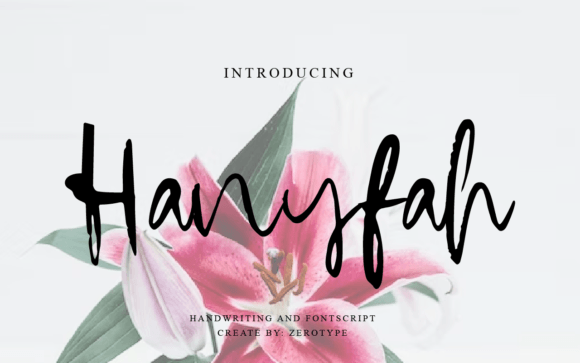
Hanyfah is a dazzling script font, but that description barely captures its personality. It is neatly crafted with high detail, which means every curve, swash, and terminal has been carefully considered. The result is a typeface that feels simultaneously luxurious and approachable. This is not a casual handwritten scrawl that you might use for a quick social media post. It is a premium display font designed to command attention on product labels, packaging, business cards, and header graphics. The letterforms carry a natural rhythm—they flow into each other without feeling disconnected or forced. That is harder to achieve than most people realize. When you use a script font that lacks that cohesive flow, your brand name can look choppy or amateur. Hanyfah avoids that entirely. It reads like someone wrote your brand name with intention and grace, which is exactly the impression you want customers to have when they first encounter your products.
I tested the font across several materials for my candle line: a small oval label for the jar lid, a hang tag tied with twine, a thank-you card tucked inside each shipment, and a graphic for an Instagram post announcing the new look. In every format, the font maintained its integrity. The swashes did not crowd the text at small sizes, and the letter spacing held up beautifully on both glossy sticker paper and uncoated cardstock. For a small business owner who does not have a design team, that kind of reliability is invaluable. You want a font that works hard across applications so you are not constantly tweaking kerning or resizing elements to make it legible.
Where Hanyfah Shines in Real Business Materials
The first place I deployed Hanyfah was on my product labels. My candle jars are simple amber glass with a black lid, so the label is really the main branding real estate. I used Hanyfah for the candle name—something like Vanilla Bean or Cedar + Smoke—and paired it with a clean sans serif for the scent notes and ingredients below. The combination immediately elevated the perceived value of the product. Friends who received test jars commented that the labels looked like something from a boutique shop rather than a home kitchen operation. That kind of feedback matters because it directly affects how much customers are willing to pay and how they perceive the quality of what is inside the jar.
Beyond labels, Hanyfah is excellent for business cards. I printed a batch using a letterpress-style finish on thick cotton stock, and the font’s fine details caught the light beautifully. The card now sits on my desk as a reminder that good typography does not just communicate information—it communicates care. For a boutique owner, a café operator, or a handmade seller, that first physical touchpoint with a customer sets the tone for the entire relationship. A business card set in Hanyfah tells people you pay attention to detail. It suggests that your products or services are thoughtfully made, and that is a powerful subconscious message.
I also experimented with Hanyfah on social media graphics. For an Instagram post announcing a limited-edition seasonal candle, I set the headline in Hanyfah against a soft cream background with a subtle botanical illustration. The scroll-stopping factor was immediate. In a feed full of bold sans serifs and generic stock templates, a finely crafted script font stands out. It invites people to pause and read. For online shop banners on Etsy or Shopify, the same principle applies. Your header is often the first thing a potential customer sees, and Hanyfah gives it a handcrafted, premium feel that signals quality before they even click into your listings.
Readability and Practical Considerations for Small Business Use
Now, let us talk about readability, because this is where many script fonts fall short for real business applications. I tested Hanyfah at various sizes on my labels. At 14 points on a small oval sticker, the font remained clear and readable. The letterforms are open enough that they do not blend into each other, even when printed at a modest size. That is a critical detail for product packaging where space is limited. For example, if you run a bakery and want to label individual cookies or small treat boxes with a handwritten-style name, you need a font that stays legible at compact dimensions. Hanyfah delivers on that front without losing its decorative charm.
On mobile screens, the font also performed well. I tested it on an Instagram story graphic at a headline size and then scaled it down for a product thumbnail in my online shop. The swashes and flourishes did not degrade into messy noise, which can happen with overly ornate scripts. Hanyfah strikes a balance between being decorative and being functional. It is a display font, so it works best for short phrases, logos, product names, taglines, and headings. For longer body text, you will want to pair it with a simpler counterpart. That is standard practice with script fonts, and Hanyfah plays beautifully with others.
Font Pairing Ideas to Build a Complete Brand Identity
If you are building a brand identity around Hanyfah, pairing it with a clean sans serif is a reliable and effective approach. The contrast between the flowing, elegant script and a crisp, modern sans serif creates visual tension that feels intentional and polished. For my candle labels, I used a light-weight geometric sans serif for the scent notes and a medium-weight version for the net weight and warning text. The combination felt balanced and professional without competing for attention.
For a café refreshing its menu, Hanyfah could anchor the header for each category—Coffee, Tea, Pastries—with a simple serif or sans serif below for descriptions and prices. A boutique creating clothing tags might use Hanyfah for the brand name and a minimalist sans serif for care instructions and sizing. A skincare brand could set product names in Hanyfah on the front of a bottle and use a clean sans serif on the back panel for ingredients. The versatility of this font allows it to act as the hero of your design while letting supporting typefaces handle the heavy lifting of readability. Pairing Hanyfah with a light handwritten font or a modern serif can also work, especially for brands that lean more artistic or editorial. The key is to keep the pairing simple so Hanyfah remains the star.
What to Check Before Using Hanyfah Commercially
Before you start printing labels or updating your website banner, take a moment to review the included styles and file formats. Hanyfah typically arrives as a script font with standard character sets, but it is worth checking whether it includes alternates, ligatures, or swash variations. Those extras can give you flexibility when designing logos or headlines. For example, if you want the first letter of your brand name to have an elegant flourish, a stylistic alternate can make that possible without manually editing vectors. Ligatures ensure that certain letter combinations connect smoothly, which keeps the handwritten feel intact.
Also confirm the font’s licensing terms before you use it on products, packaging, merchandise, templates, client work, or digital downloads. Font licensing can vary significantly between personal use, commercial use, and extended redistribution. For a small business owner selling physical products or offering design services, a standard commercial license is usually sufficient, but always read the specific agreement that comes with your purchase. It saves headaches later and ensures you are using the font ethically and legally. The last thing you want is to build a brand identity around a font only to discover you need to upgrade your license or switch typefaces after you have already printed inventory.
Once you have those details sorted, Hanyfah becomes a reliable asset in your design toolkit. It is the kind of font that does not just sit in your library collecting dust—it inspires you to use it. Every time I open a project file and see those elegant curves, I feel motivated to make the design better. That alone is worth the investment for any small business owner, creative consultant, or entrepreneur who cares about how their brand shows up in the world.
If you have been searching for a script font that feels refined yet approachable, Hanyfah deserves a close look. It has the potential to transform a basic label into a memorable brand touchpoint, a simple business card into a conversation starter, and a standard social graphic into something that stops the scroll. In a crowded marketplace, those small moments of polish add up. They tell customers that you care about the details, that your products are made with intention, and that your brand is worth remembering. That is the kind of impression every small business owner hopes to leave.